
 亞洲大學3D列印研究中心
|
|
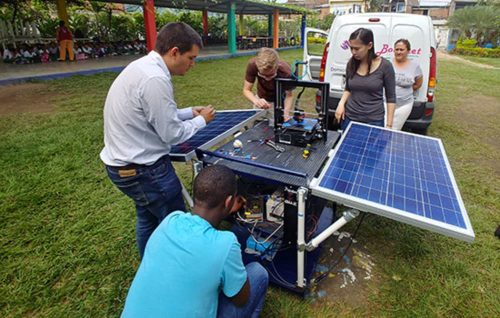
A major issue with 3D printing is that it is not as widely available around the world as it should be. While this may not seem like a pertinent issue, many developing communities and their businesses are losing out on the major benefits of modern technology, making them less competitive in the long run. So, it’s only natural that students from Rochester Institute of Technology (RIT) are attempting to remedy this. Their new solar powered 3D printer provides much needed access to additive manufacturing in developing regions of Columbia.
Six electrical, industrial and mechanical engineering students produced this versatile power system. What the students created, however, is not just a solar-power rig. It actively senses sense when solar energy can be obtained all on its own. The system connects to a consumer standard FDM/FFF printer and can seamlessly switch between power sources. In the event of a black-out or inconsistent power flow, the printer can resume work uninterrupted.
Solar Powered Solutions & Eco-Friendly Manufacturing
This wasn’t the team’s only eco-friendly project under their wing. They collaborated remotely with students in the Universidad Autónoma de Occidente in Cali, Colombia, who had been tasked the job of developing a method to use plastic bottles as reinforcement within the 3D printing filament. Recycling projects can not only help the environment, but also significantly reduce material costs. Additionally, areas without electricity are not likely to have access to filament and this provides that.
The students chose Cali due to it’s unfortunately destitute nature. The social conditions are very harsh and giving the youth desirable skills serves as a step in the right direction. Social projects such as this are crucial to giving developing communities a leg up. While it won’t instantly fix all the problems, it can at least bridge the opportunity gap between Cali and more fortunate areas.
Featured image retrieved from Engineering.com
